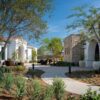
Designing with the Marsh: The Vision Behind Magnolia Coast
For nearly a decade, Magnolia Coast has been an evolving vision — a coastal community shaped by the rhythms of the marsh, the histories of Huntington Beach, and a commitment to expressive, ecologically attuned design. In partnership with Shopoff Realty Investments, WATG (hospitality architecture), and JZMK Partners (residential architecture), our team at Land Concern has helped reimagine this former oil tank farm into a vibrant tapestry of community, hospitality, and open space.

From Industrial Footprint to Ecological Landmark
Located adjacent to the Talbert and Magnolia Marshes and in proximity to the Santa Ana River Trail, Magnolia Coast is grounded in one of California’s most dynamic ecological zones. This history and location drove our team to respond with landscape architecture that does more than beautify—it communicates the deep narrative of place.
From the early 2016 design concepts to the 2024 schematic plans, our work has embraced the alluvial patterns, natural systems, and lived experiences found at the edge of the Pacific. The design of the site echoes this terrain — undulating paths, shifting ground planes, and planting palettes that transition from upland meadow to riparian woodland and coastal dune.

Design Principles Inspired by the Marsh
1. Form Follows Flow
The marsh and its tributaries became our guiding geometries. Our plazas, fountains, and pathways follow a meandering, almost tidal logic. At the Lodge, for instance, the Breaking Wave Fountain and Tidal Source Fountain draw from estuarial dynamics — one invoking the rhythm of surf, the other evoking the gentle birth of a stream.

2. Marsh-Inspired Placemaking
The community is anchored by thoughtfully designed nodes like Marsh Park, which features interpretive trails, amphitheaters, boardwalks, and native plantings. These elements offer educational and immersive experiences without compromising the site's character. Spaces such as the Learning Nest, Bird Blind, and Watershed Garden serve as living classrooms that honor the local ecosystem while enhancing community awareness.

3. Layered Ecology Meets Human Experience
From pocket parks and nature-themed shade structures to hammock gardens and open lawns, the design layers recreational and contemplative moments across the site. These spaces are not only responsive to habitat and hydrology but also intuitive for the people who will live, stay, and gather here.

Reinventing the Coastal Gateway
One of Magnolia Coast’s boldest aims is to reconnect the public to the coast. Through a robust pedestrian network, seamless trail linkages to the Santa Ana River and Huntington Beach Wetlands, and open plazas that celebrate regional art and culture, the project restores both ecological and social access to land once closed off by industrial barriers.


Rooted in History, Oriented to the Future
The Magnolia Coast site holds a layered past — from its origins as coastal marsh and waterfowl habitat to its industrial era as an oil tank farm. This rich, often overlooked history shaped our entire design process. Rather than erase the land’s memory, we sought to express it — to let the terrain, ecology, and cultural context inform a new chapter rooted in restoration.
We studied aerial maps, walked the marsh, traced the pathways of former wetlands, and overlaid those movements into the geometry of trails, amphitheaters, and public spaces. This process of site reading wasn’t about nostalgia — it was about belonging. The result is a place that feels both new and ancient, designed not just to look beautiful but to feel inevitable.

Magnolia Coast doesn’t simply reclaim land — it reclaims meaning. In reconnecting people to this coastal edge, we honor the rhythms that shaped it, the stories that lived here before, and the future communities that will grow from it. This is a place made not just for now — but for the next hundred years.
Collaborators Who Shared the Vision
- Shopoff Realty Investments brought vision and tenacity as the project’s lead developer.
- WATG infused the lodge and resort areas with hospitality-driven fluidity.
- JZMK Partners articulated the residential cores with attention to coastal living patterns.
- Land Concern led the landscape architecture from conceptualization through schematic design, defining an identity that is both organic and iconic.